 Terminal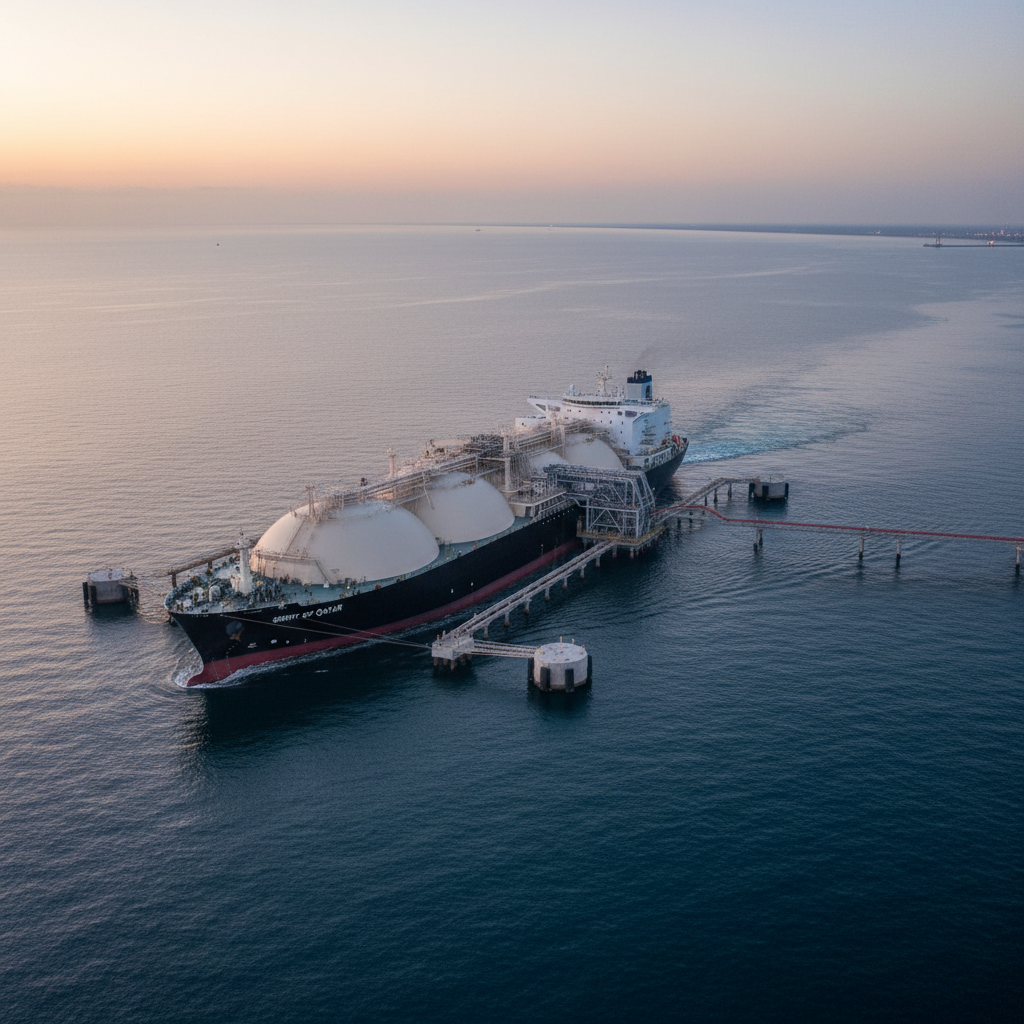
FromCargoto Grid.
Deepwater LNG regasification at minus 160°C. Supercooled methane arrives by Q-Flex carrier and leaves as pipeline-grade gas feeding city grids before morning coffee brews.
Follow the Molecule
From ship manifold to pipeline tie-in — every stage controlled, every cubic metre accounted for.
Carrier Arrival & Berth Assignment
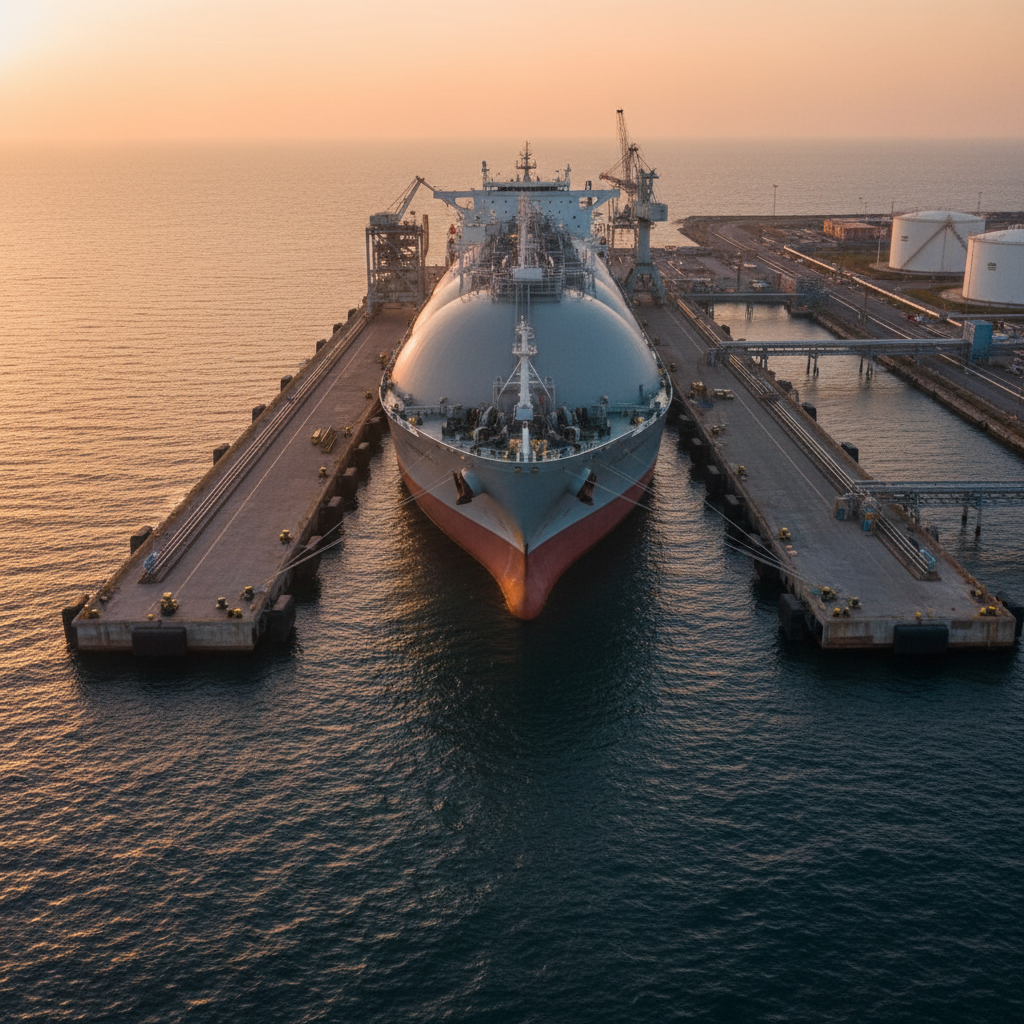
Q-Flex and Q-Max carriers coordinate approach via our Vessel Traffic System 72 hours out. Tug assists, mooring master boarding at outer anchorage, berth allocation confirmed against live storage inventory.
Our three-berth facility accommodates simultaneous unloading and cool-down cycles. Each berth is rated for carriers up to 266,000 m³ capacity with a guaranteed 26-hour turnaround on standard cargo.
Cryogenic Transfer Arms Lock
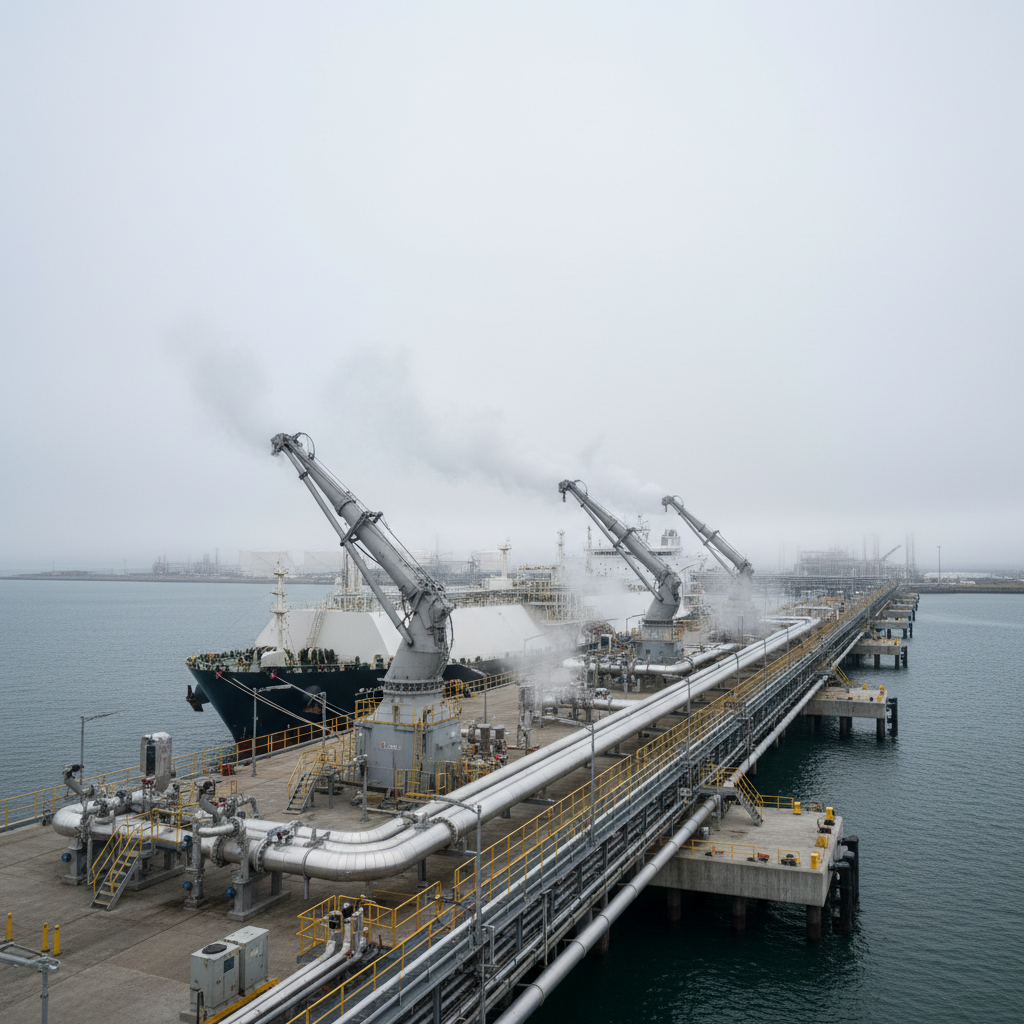
Marine Loading Arms (MLAs) swing into position and lock onto the ship manifold. Transfer commences at −160°C through vacuum-jacketed piping. Vapor return lines maintain pressure balance across the ship tank.
Each MLA is rated at 12,000 m³/hr transfer rate. Emergency Release Coupling (ERC) systems activate within 0.8 seconds of any mooring tension exceedance, protecting both asset and environment.
Full-Containment LNG Storage
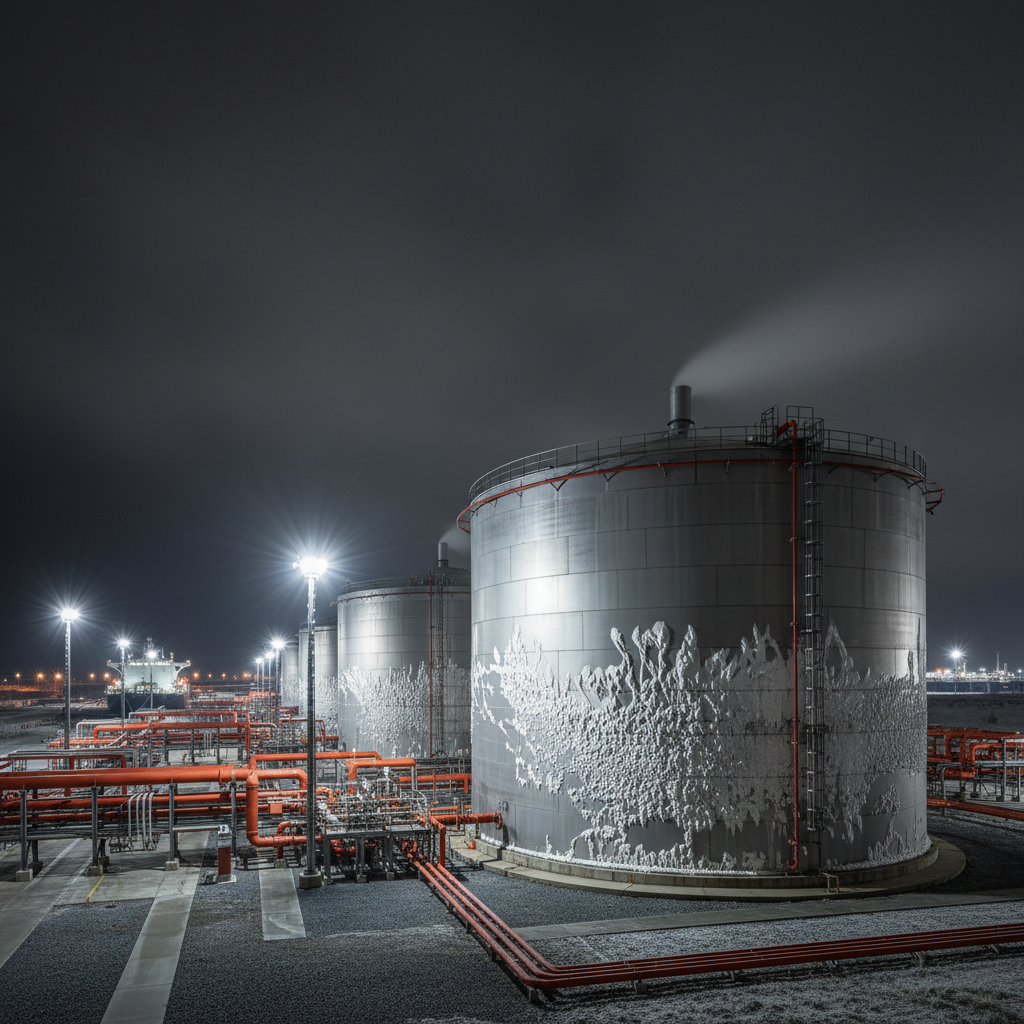
LNG is pumped to four full-containment tanks, each with 180,000 m³ capacity. Boil-off gas (BOG) generated by heat ingress is recovered via BOG compressors and fed directly to the high-pressure send-out stream.
Tank pressure is maintained at 25–30 mbar. BOG recovery efficiency exceeds 99.1%, eliminating flaring under normal operations. Stratification monitoring prevents rollover events.
High-Pressure Vaporization
Submerged Combustion Vaporizers (SCVs) and Ambient Air Vaporizers (AAVs) convert LNG to gas. SCVs provide rapid-response baseload; AAVs handle peak summer demand with zero fuel consumption.
Vaporizer trains deliver gas at 72–80 bar outlet pressure, metered to ±0.25% accuracy. Warm-up sequencing ensures no cold-gas exceedance at the pipeline tie-in point.
Pipeline Custody Transfer
Gas exits through our metering station at the National Transmission System (NTS) tie-in. Ultrasonic fiscal meters provide custody transfer measurement compliant with OIML R137 and ISO 17089.
Maximum send-out capacity is 620 MMSCFD. Firm capacity holders receive dedicated metering runs with independent verification. Calorific value and Wobbe Index are continuously monitored.
P&ID — BRT-001 / BRT-002 / BRT-003
Carrier Arrival & Berth Assignment
P&ID — MLA-001 / VRS-002
Cryogenic Transfer Arms Lock
P&ID — TK-001 / TK-002 / TK-003 / TK-004
Full-Containment LNG Storage

P&ID — SCV-001–003 / AAV-001–003
High-Pressure Vaporization

P&ID — MS-001 / NTS-TIE
Pipeline Custody Transfer
Capacity at a Glance
Live operational parameters · Updated 04:17 UTC
Firm send-out capacity available under peak-demand throughput agreements
Four full-containment tanks across two tank rows
Boil-off gas captured and reinjected — zero routine flaring
Guaranteed turnaround from first line fast to last line let go
Averaged across all three berths — 2021 to 2025
Ultrasonic custody transfer per ISO 17089
Operational Intelligence
Technical papers, commercial frameworks, and regulatory guidance — no registration required.
Boil-Off Gas Management: Zero-Flare Operations
Detailed methodology for BOG compressor sequencing, reliquefaction integration, and achieving <0.05% daily evaporation rate across all four storage tanks. Includes real operational data from 2023–2025.
Slot Optimisation Methodology for LNG Traders
How to maximise cargo scheduling windows within our berth allocation framework. Covers 72-hour advance nomination, force majeure provisions, and swing capacity for spot cargo integration.
Emissions Reporting Framework — IPCC Tier 3
Scope 1 and Scope 2 emissions methodology, fugitive release monitoring protocols, and annual GHG inventory aligned with EU Taxonomy and TCFD disclosure requirements.
Cryogenic Piping Integrity & Inspection Programme
Risk-based inspection intervals, cold-shock prevention procedures, and non-destructive testing schedules for vacuum-jacketed transfer piping and marine loading arms.
Winter Peak Demand: Securing Firm Regasification Capacity
Capacity reservation mechanisms, interruptible versus firm throughput agreements, and the economic case for pre-booked send-out slots during Q4–Q1 peak demand periods.
Terminal Safety Case Summary — Public Version
Non-confidential summary of the Major Hazard Review, exclusion zone methodology, and emergency response procedures for vessel incidents, LNG spillage, and vapour cloud scenarios.
Secure Your Throughput

- Full P&ID package — all five process stages
- Berth scheduling calendar & slot availability
- Throughput agreement framework (indicative)
- Send-out pressure & calorific value specs
- Emergency response and SIMOPS procedures
Not ready for the full package?
Download Public Capacity FactsheetNo registration · 2-page summary · Immediate download
Download Terminal Specs
Enter your company email and we'll send the complete technical specification pack — 47 pages covering all five process stages, capacity parameters, and commercial framework.